

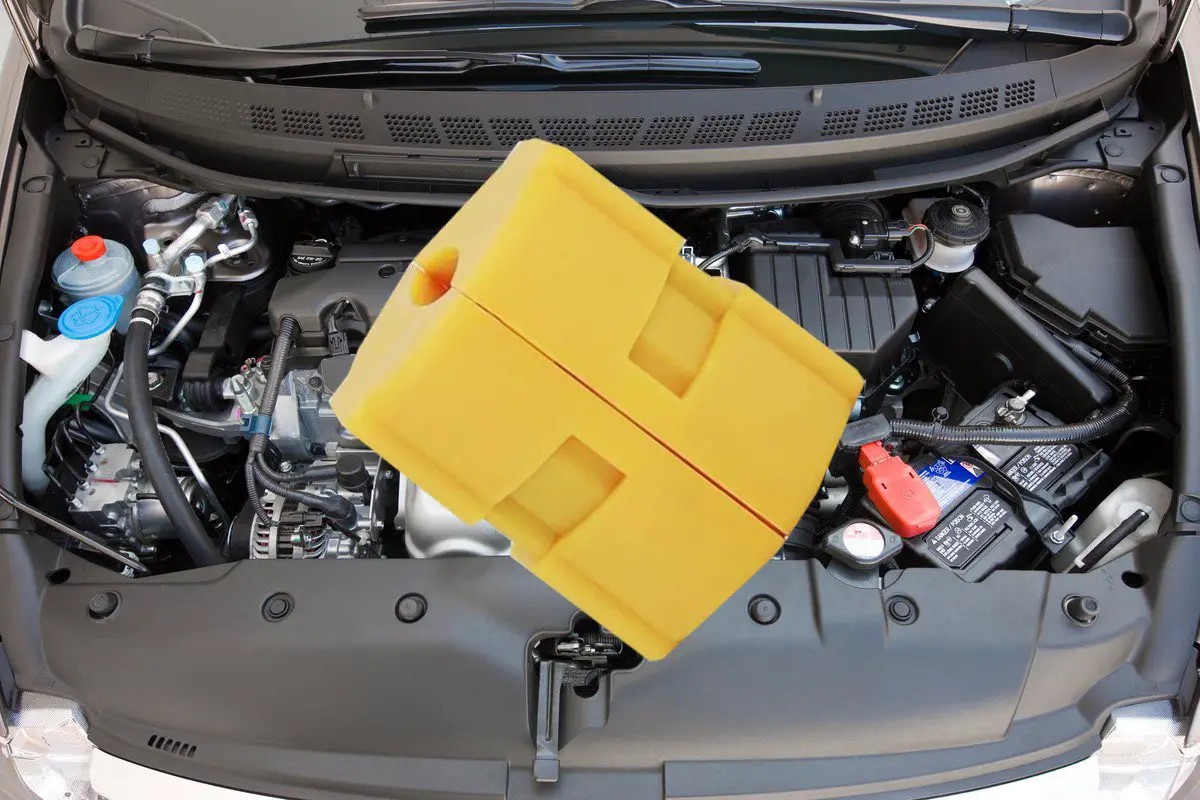
Using the properties of magnets, these clip-on devices claim they arrange chaotic gasoline molecules for a more efficient fuel combustion.
As gas prices hit record highs, drivers around the world are searching for quick fixes to increase their fuel efficiency as cheap as possible, and that means the re-emergence of fuel saving devices.
One of the oldest fuel saving devices, easily debunked, yet still on sale on eBay, Amazon, and any online commerce site that will take them, are these magnetic fuel savers.
Coming in all kinds of colors (commonly yellow and blue) , these magnetic fuel savers are sold in pairs, are mostly cylindrical, have no moving parts, and promise to not only save fuel, but reduce emissions, increase performance, extend engine life, and offer quicker start-up times.
For such a game changing device that costs less than $20 and is maintenance free, it’s a no-brainer.
Here’s a four-pack on Amazon for $15.
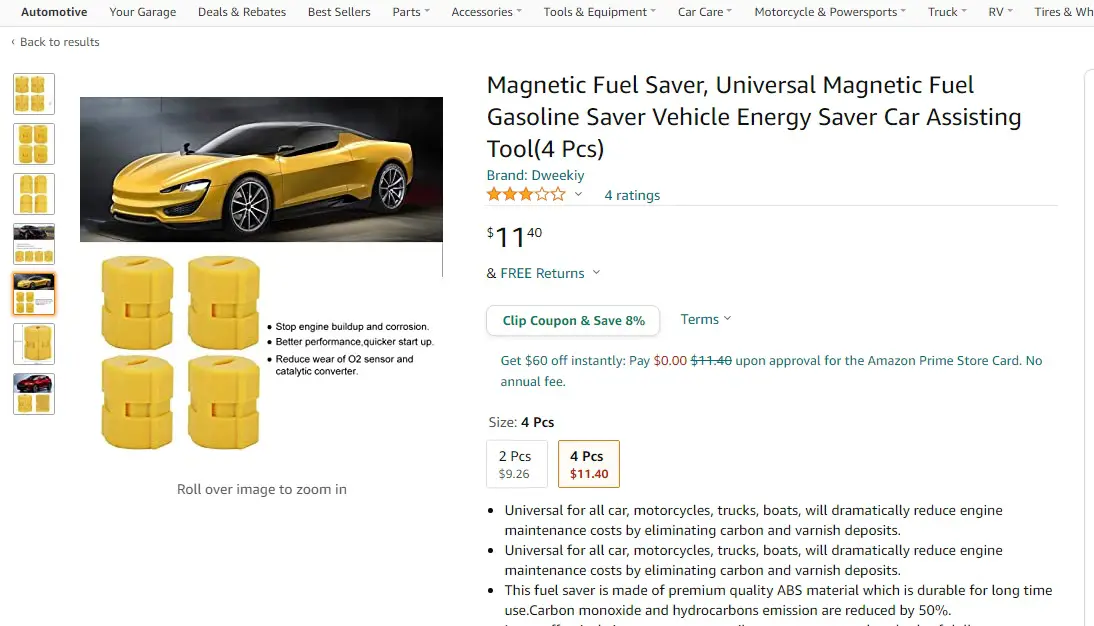
Fortunately, for you, someone who’s doing their research and has not bought one yet, they do not work, are not backed up by scientific data, and are a complete waste of your time and money.
Here’s why.
Pseudoscientific working principles-
Like most pseudoscience, the claimed working principles are often based on kernels of truth. While it’s true that magnets and their magnetic fields can affect liquids, like water, the magnetic powers required to affect water molecules is often performed by strong, high-current superconducting electromagnets, magnets several magnitudes more powerful than any cheap clip-on magnets.
And, even then, magnetic fields do not affect liquids like these devices claim they do.
For one, these devices claim to take the chaotic string of fuel molecules, evenly aligning them for more fuel efficient combustion. Molecules, as you may know, are vibrating at high speeds at all times. Even if these gasoline macromolecules were aligned by a magnetic force, after they passed through the magnets, they’d instantly become unaligned and return to normal.
😂😂😂 orderly and ionized. Is your fuel activated? pic.twitter.com/OpiihkzDvT
— We stan Fat Civic aka ’23 Integra (@ferio_252) March 15, 2022
These devices provide no proof or experimental data showing molecules are actually aligning.
Another claim is these magnets break up macromolecular clusters of gas into smaller molecular clusters which reduces fuel viscosity, increases atomization, and, more efficiently, burns gasoline.
It’s true that gas and diesel are made of different combustible molecules like Methane and Pentane, CH4 and C5H12, respectively.
And, large molecules can be broken down into smaller molecules, but we’re talking about specific endothermic and exothermic reactions that require intense amounts of heat, pressure, and some type of chemical reaction to spark that off.
Think fireworks or diamond formation.
There’s no way any type of tiny magnet is causing any specific chemical reaction to happen in gasoline by passing over cheap magnets.
According to the World Nuclear Association, the caloric values of large and short chain hydrocarbons of Gasoline range between 44-46 MJ/G. Even if a magnet DID break down large-chain hydrocarbons into smaller, shorter-chain ones, short-chain hydrocarbons don’t necessarily give off that much more energy during complete combustion.
The exact blend of gasoline, like KFC’s secret mix of spices, is tweaked to perfection over the years, matching the needs of the modern combustion engine. There is no tuning, done by magnets or otherwise, to further improve the burning characteristics of gasoline as it comes from the pump nozzle.
Finally, these types of devices claim to improve fuel burn by improving the magnetic resonance of fuel through neodymium superconductors.
It’s the same type of claim magnetic device maker Super FuelMAX claimed in the early 2000s, claiming,
“A certified EPA laboratory reports an amazing 27% in increased mileage and 42% reduction in harmful pollutants.”
The Federal Trade Commission investigated those claims and alleged that,“‘the magnetic “fuel saver” does not save fuel, does not increase gas mileage, and does not reduce emissions.”
The makers of FuelMAX and Super FuelMAX were ordered to pay $4.2 Million.
The logical truth
As I pointed out in another fuel-saving device blog post, if such a cheap magnet worked as it purports it does, wouldn’t car manufactuers JUMP at the opportunity to install them on all their cars?
That goes for racecar teams, our nation’s trucking industry, and anyone who drives for a living, if such a competitive edge exists, you’d think these magnets would be an industry best practice.
The simple truth is magnets, at least on this scale, have no effect on gasoline to help fuel burn more efficiently.
These scam devices are often Made in China and readily available for sale on wholesale sites like AliExpress.com (click here to see for yourself) for as little as .46 (that’s 46 cents!)
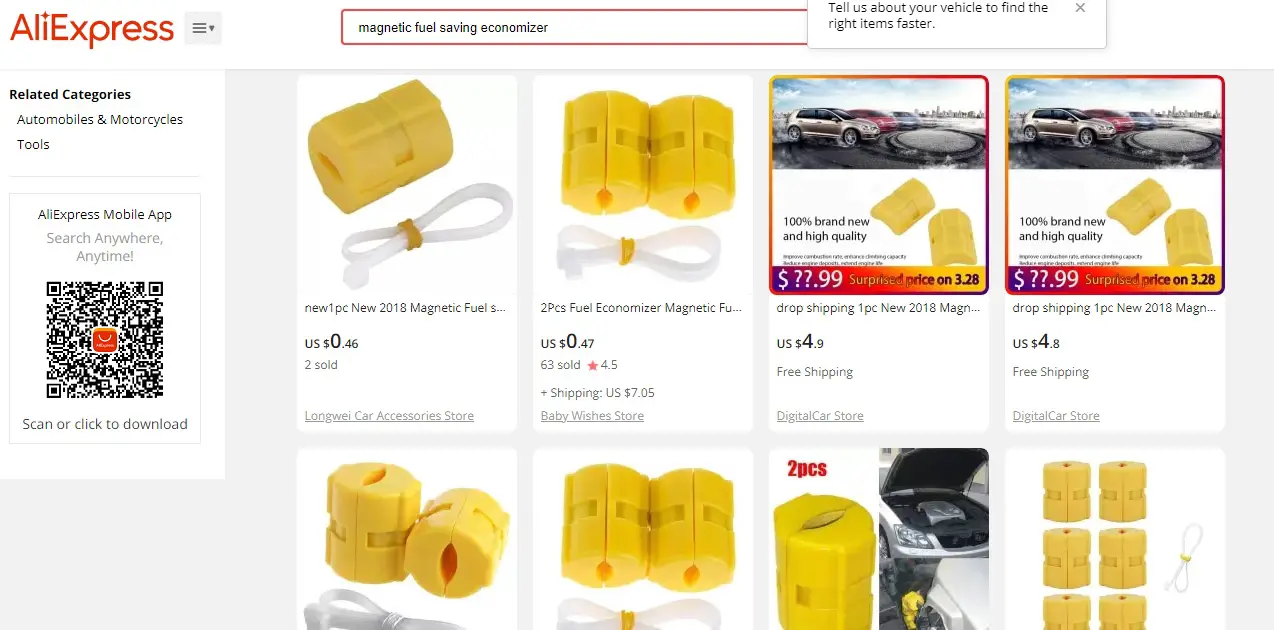
They’re re-sold to you on Amazon, eBay, or whatever for 20x more than they bought them for. It’s no wonder they’re still on sale.
So, if you see these magnet-types of devices for sale, click away and don’t waste your time and money.
It’s akin to modern day snake oil.

I’ve used Magnetizer Fuel Maximizer for the last ten years on several cars, and also my previous motorcycle – a Yamaha YS125. Given that that the magnet/magnets is/are properly mounted, it/they improves the combustion process as advertised, on par with one of the leading fuel additives worldwide, namely Mergi Combustion Catalyst. I’ve added MCC to the fuel, both diesel and petrol, for the last twentyfive years. And I’ve experimented with fuel magnets since 2006. If the magnetic field is too weak or too strong, it gives no effect or negative effect. Depending of the engine size, and if it’s a diesel or petrol engine, one, two, three or even more magnets are necessary for positive effect. One Fuel Maximizer is too strong for a 125cc four-stroke engine, and it’s therefore necessary to put a thin piece of rubber or plastic between the magnet and the fuel line. The torque at low rpms improves substantially, but the top effect can suffer. To counter that and improve drivability at both low and high rpms, it is necessary to replace the standard spark plug with a one step colder spark plug. I did that on both the motorcycle and my previous car, a Toyota Corolla 1600cc, with good results.
“The experiments in current research comprise the using of permanent magnets with different intensity (2000, 4000, 6000, 9000) Gauss, which installed on the fuel line of the two-stroke engine, and study its impact on gasoline consumption, as well as exhaust gases. For the purpose of comparing the results necessitated the search for experiments without the use of magnets. The overall performance and exhaust emission tests showed a good result, where the rate of reduction in gasoline consumption ranges between (9-14) %, and the higher the value of a reduction in the rate of 14% was obtained using field intensity 6000 Gauss as well as the intensity 9000 Gauss. It was found that the percentages of exhaust gas components (CO, HC) were decreased by 30%, 40% respectively, but CO2 percentage increased up to 10%. Absorption Spectrum of infrared and ultraviolet radiation showed a change in physical and chemical properties in the structure of gasoline molecules under the influence of the magnetic field.” https://www.sciencedirect.com/science/article/pii/S1876610212008144